Before you go...
We built a free scorecard that shows how your heat pump, ventilation and solar systems are performing. Results are usually surprising.
Get my score
No thanks
We built a free scorecard that shows how your heat pump, ventilation and solar systems are performing. Results are usually surprising.
No thanksWe built a free scorecard that shows how your heat pump, ventilation and solar systems are performing. Results are usually surprising.
No thanks
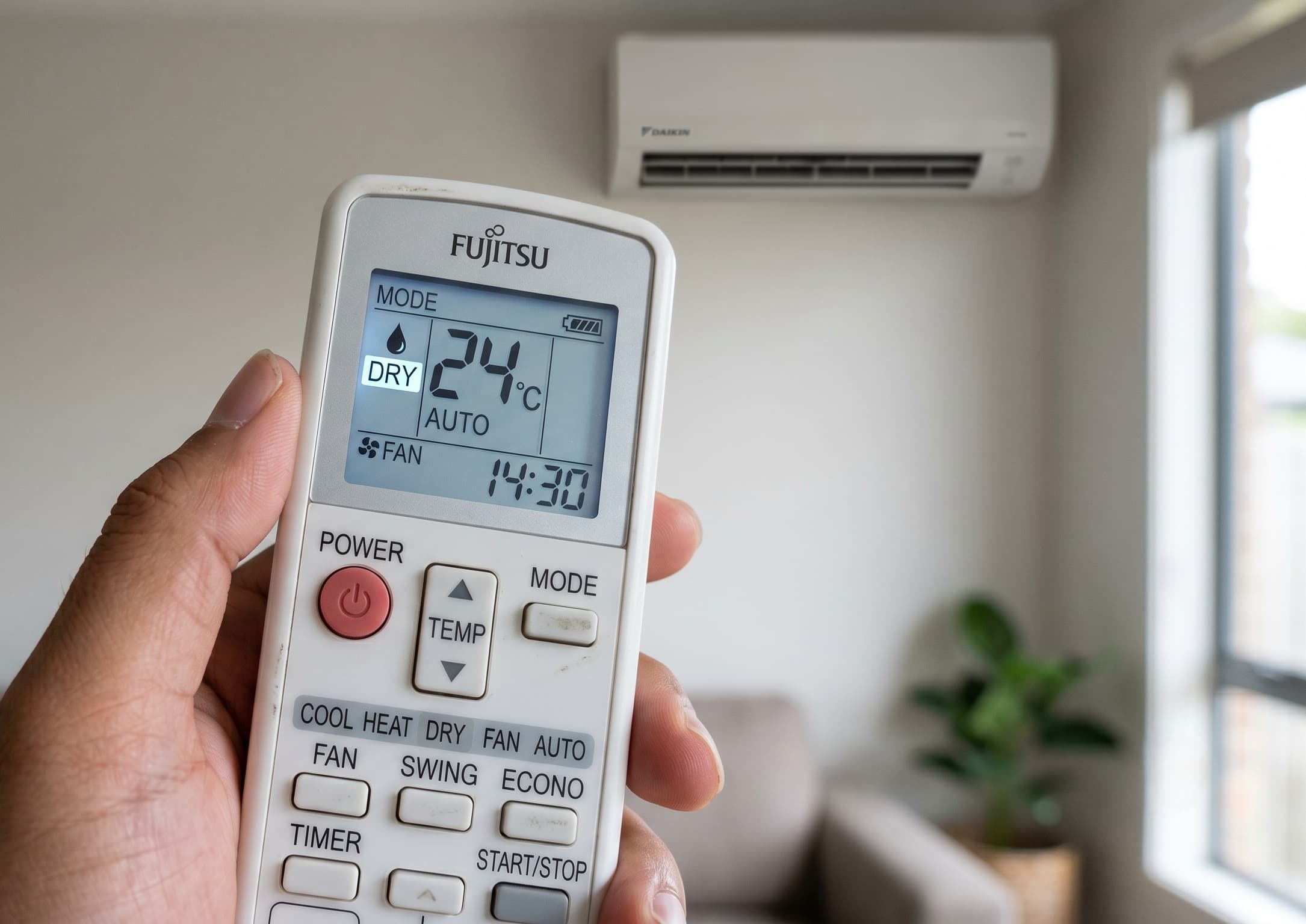
Dry mode, also called the dry setting on some remotes, is the closest thing a heat pump has to a dedicated dehumidifier. It sits on the remote between cooling and fan-only, and most homeowners have either never touched it or used it at the wrong time of year. It causes particular confusion in winter, when condensation is a problem and heating is what's actually needed. This guide explains what dry mode does mechanically, when it's the right choice, and what it won't do no matter how long you leave it running.
Dry mode is a heat pump setting that removes moisture from the air without heating or actively cooling the room. It sits on the remote between cooling and fan-only, and it's built for days when the air feels humid but the temperature is already comfortable. Unlike cooling mode, dry mode isn't designed to bring the temperature down. Unlike heating mode, it can't warm the room while it's running. It's a dedicated dehumidifying function, and it works best in mild, humid conditions rather than on hot or cold days.
Yes. A heat pump dehumidifies the air by running dry mode, a dedicated setting that removes moisture without heating or actively cooling the room. It sits on the remote between cooling and fan-only, built for days when the air feels humid but the temperature is already comfortable.
A heat pump dehumidifies by cooling the internal coil below the dew point so moisture in the air condenses on its surface. The indoor fan locks to its lowest speed automatically and can't be changed manually while dry mode is running. As air passes over the cold coil, moisture collects and drains away through the drain line rather than returning to the room. The compressor cycles on and off between dehumidifying and fan-only operation, and the fan sometimes stops completely between cycles. This is intentional. It stops the moisture that's just been collected from evaporating back off the coil and into the room. The result is air that's drier but at roughly the same temperature, since the process is built to dehumidify rather than actively reduce temperature.
Most brands recommend running dry mode when the indoor temperature is between 18°C and 32°C, though Mitsubishi Electric's residential units specify a tighter 21°C minimum. Outside a brand's stated range, dry mode either won't engage or won't achieve meaningful dehumidification.
BrandTemperature guidanceSamsungSet target temperature between 24°C and 26°CPanasonicSet target 1°C to 2°C below current room temperatureFujitsuSet target lower than current reading, as a reference point for cyclingMitsubishi ElectricWall-mounted and floor console models: temperature is fixed and cannot be set. Ducted and wired-controller systems: adjustable between 19°C and 30°CDaikinTemperature cannot be adjusted manually. Selecting Powerful mode automatically lowers the target by 2.5°C to speed up moisture removalToshibaFully adjustable between 17°C and 30°C. The remote beeps twice at 24°C as a suggested baselineHitachiDehumidifying function will not work below 15°CCarrierCompressor stops below 10°C, won't restart until above 12°C
Adjustability varies more than most owners expect. Mitsubishi Electric and Daikin lock the temperature setting on most residential wall units, since the system manages airflow and compressor speed automatically rather than chasing a target. Toshiba goes the other way, giving full manual control across a wider range. If your display greys out the temperature figure the moment you select dry mode, that's standard behaviour for your brand, not a fault.
The water droplet or raindrop icon on your remote means dry mode. This symbol is consistent across the major brands most commonly installed in New Zealand. Mitsubishi Electric, Daikin, Fujitsu, Panasonic, Hitachi, and Toshiba all use a water drop to represent dry or dehumidifying mode.
Dry mode works best when the air feels heavy and humid but the room temperature is already comfortable. Post-rain days in Auckland and the upper North Island are the clearest example. The room isn't hot enough to need cooling, but the humidity is noticeable and you want to take the dampness out of the air.
Overcast summer days with mild temperatures and high humidity are another good fit. You'd be overcooling the room on cool mode, but something needs to deal with the moisture. Dry mode is the right tool.
Dry mode cannot heat a room while removing moisture, which makes it the wrong choice for NZ winters.
Dry mode produces a cooling side-effect as part of how it removes moisture. The compressor cools the internal coil below the dew point to cause condensation. That process cannot happen without also cooling the air. Manufacturers are explicit on this point. Fujitsu states you cannot heat the room during dry mode. Samsung states dry mode is designed to produce a cooling side-effect and cannot be used for heating.
Panasonic states explicitly in its manual that dry operation is not possible if the outdoor temperature is 15°C or below. That threshold covers a significant portion of Auckland winter mornings. On those days, the system either won't enter dry mode properly or won't achieve meaningful dehumidification.
If you run dry mode on a cold winter morning to clear window condensation, the room will get colder. The condensation on your windows is a symptom of cold glass surfaces meeting warm humid air inside. Heating mode, run consistently, raises the surface temperature of walls and glass over time and is a far more effective response to winter condensation than dry mode.
Switching directly from dry mode to heating releases the moisture the system just collected back into the room as warm, humid air.
When dry mode runs, moisture condenses on the internal coil and sits in the drain system. If you switch directly from dry mode to heating mode, the coil heats up rapidly and that collected moisture evaporates back into the room immediately, so you get a burst of warm, damp air at once. Windows that were already condensating will get worse in the seconds after you make that switch.
If you need to move from dry mode to heating, run the unit on fan-only mode for a few minutes first. This dries the internal coil before the compressor starts heating. No manufacturer manual covers this transition specifically. It's an observation passed on by owners who have experienced the humidity spike firsthand.
Fan speed: Locked to automatic low speed on every brand. Cannot be changed while dry mode is active.
Temperature: Adjustability varies significantly by brand. See “What temperature should I set dry mode to?” above for the full breakdown. Daikin and Mitsubishi Electric wall-mounted and floor console models lock the setting entirely, since the system manages it automatically. Toshiba, Samsung, Panasonic and Fujitsu allow manual adjustment. If your display greys out the temperature figure, that's standard behaviour for your brand, not a fault.
Other modes: Quiet mode is unavailable during dry mode on Mitsubishi Heavy Industries, Panasonic, Toshiba, Samsung, and Gree. Turbo and high-power modes are also disabled during dry mode on Mitsubishi Heavy Industries, Panasonic, and Toshiba.
Airflow direction: Behaviour varies by brand. Fujitsu's louver returns automatically to a mid position if left pointing down for more than 30 minutes, to stop condensation forming at the outlet and dripping onto furniture. Mitsubishi Electric does something similar: if the horizontal vane points downward in cool or dry mode for around half an hour to an hour depending on the model, the system automatically returns it to horizontal to prevent the same dripping issue. Daikin locks the airflow rate automatically in dry mode. Louver direction stays manually adjustable, unless Comfort Airflow is switched on, which locks the flap upward to avoid direct drafts. Daikin's manuals don't include a timed downward-vane override. Toshiba also leaves louver position fully adjustable with no automatic correction. It advises manually setting the louver to its maximum angle and selecting high fan speed if condensation appears. Across all brands, operating above 80% relative humidity increases the risk of condensation forming on the indoor unit and dripping, regardless of louver position.
Brand-specific features: LG units include a Jet Dry function that maximises dehumidification output when activated. It is available during dry mode and runs at increased performance until cancelled. Select Gree models include a low-temperature drying function. When the set temperature is at the minimum 16°C in dry mode, pressing the temperature down button twice drops the target to 12°C and activates this mode.
Several brands run an automatic internal dry-out sequence when dry mode finishes. This keeps the indoor fan running after the compressor stops, blowing residual moisture off the internal coil to prevent organic growth from developing inside the unit.
Toshiba runs a 30-minute self-cleaning operation after dry mode stops. LG runs an automatic clean operation for around 30 minutes. Rinnai runs a 3-minute MILDEW function after every shutdown. Daikin runs a 60-minute MOLD PROOF operation that dries the inside of the unit while streamer discharge reduces mould and odour development. Mitsubishi Heavy Industries runs a two-hour SELF CLEAN operation that removes moisture from the indoor unit.
Hitachi runs a mould guard function after cooling or dry operation stops, running the indoor fan to dry the unit and suppress mould generation.
Panasonic units with nanoe-G run the fan for 30 minutes with the louver slightly open after dry mode finishes to dry internal parts.
Fujitsu does not run an automatic dry-out sequence. Compatible Fujitsu remotes include a manual COIL DRY button. Pressing it after dry mode finishes runs the indoor unit to dry the coil and inhibit mould and bacteria growth. If your Fujitsu remote has this button, using it after dry mode is the manufacturer's recommended approach.
Coil dry is Fujitsu-specific terminology. No other major brand sold in NZ uses this exact button or cycle name. If you've seen the term without knowing which brand you have, it almost certainly means you're looking at a Fujitsu unit. For the full breakdown of the 48-minute cycle and its limits, see the coil dry guide for Fujitsu heat pumps.
Mitsubishi Electric does not include an automatic dry-out cycle on all models. Their documentation recommends running the unit in fan mode for three to four hours before any extended period of non-use to dry the inside of the unit. If your model doesn't run an automatic cycle after dry mode, this is the approach the manufacturer recommends.
Dry mode and a dehumidifier both remove moisture from the air, but they're built for different jobs. Mitsubishi Electric's own documentation states that heat pumps offer limited dehumidification in dry mode and that specialised moisture control products may be required to address excess moisture concerns. A standalone dehumidifier runs continuously at full extraction capacity and is purpose-built for heavy moisture removal. A heat pump in dry mode cycles its compressor on and off at low speed. It's designed for managing ambient humidity when the room is already at a comfortable temperature.
For laundry rooms, basements with persistent moisture, or any space where water extraction is the primary job, a dedicated dehumidifier is the right tool. Dry mode on your heat pump is for managing ambient humidity on humid days, not solving a structural moisture problem.
If dry mode used to make a noticeable difference and it no longer does, the issue is often the system rather than the mode.
The internal coil needs to be clean to condense moisture effectively. When a layer of organic growth develops on the coil surface, heat exchange efficiency drops. The coil can't get cold enough to condense moisture properly, and dehumidification performance falls away.
The drain pan and drain line are the other common factor. Collected moisture drains away continuously during dry mode operation. If the drain line is partially or fully blocked, moisture can't escape. Daikin's documentation notes that a blocked drain outlet can cause condensation to form and drip from the unit. You may also notice the room staying humid regardless of how long the system runs.
These aren't mode problems. They're maintenance problems. MiHT Home Energy System Care covers both as part of a standard heat pump service visit, including internal coil condition, drain pan inspection, and drain line clearance. If dry mode used to work and doesn't anymore, a service is the starting point, not a settings change.
For our complete library of heat pump, ventilation and solar guides, browse our full sitemap.
Dry mode is a heat pump setting that removes moisture from the air without heating or actively cooling the room. It sits between cooling and fan-only on the remote, sometimes labelled the dry setting, and it's built for humid days when the temperature is already comfortable.
Use dry mode when the air feels humid but the room temperature is already comfortable. Post-rain days and overcast summer days with high humidity are the clearest fit. Manufacturers recommend using it when indoor temperatures are between around 18°C and 32°C. It's not suitable for cold days or winter use.
Dry mode produces a mild cooling side-effect because the compressor cools the internal coil to cause condensation. The room will be slightly cooler after running dry mode. It is not the same as cooling mode and is not designed to lower room temperature significantly.
No. Dry mode cannot heat and dehumidify at the same time. The process that removes moisture requires the coil to be cold, which produces a cooling effect. Manufacturers are explicit that dry mode cannot be used for heating.
Heat mode does reduce relative humidity as a side effect because warm air holds more moisture, making the air feel less damp. However, this is different from active dehumidification. If moisture removal is the goal, dry mode is the correct setting, provided conditions are suitable for it.
Yes, slightly. The internal coil has to be cooled below the dew point to cause condensation and collect moisture. The room will be marginally cooler after running dry mode. This is why dry mode is unsuitable on cold days and why it's not a replacement for heating mode in winter.
The indoor fan pauses between compressor cycles to prevent moisture that's just been collected on the coil from evaporating back into the room. This is normal operation on Mitsubishi Heavy Industries, Panasonic, Fujitsu, and other brands. The fan will restart automatically.
No. The fan speed is locked to a low automatic setting in dry mode on every major brand including Mitsubishi Electric, Daikin, Fujitsu, Panasonic, Hitachi, Toshiba, and Gree. Attempting to change it will have no effect.
In dry mode, a heat pump performs limited dehumidification. It is not equivalent to a dedicated dehumidifier, which extracts moisture at higher capacity and runs continuously. For a laundry room or a space with a serious moisture problem, a standalone dehumidifier is the more suitable tool.
In dry mode, yes. The internal coil condenses moisture from the air and it drains away through the drain line. In heating and cooling modes, some incidental moisture removal also occurs, but dry mode is the setting designed specifically for dehumidification.
Reduced dry mode performance is usually a maintenance symptom. A contaminated internal coil can't achieve the coil temperature needed for effective condensation. A blocked drain line prevents collected moisture from draining away. Both reduce dehumidification output and both are addressed in a professional heat pump service.
No. Running dry mode overnight in cooler temperatures will make the room increasingly cold. Set a timer to switch the unit off, or switch to a suitable mode before sleeping. On cold nights, dry mode is not appropriate.
In suitable conditions (indoor temperatures between 18°C and 32°C, moderate humidity), dry mode provides useful background dehumidification. In cold conditions or high humidity above 80% relative humidity, performance drops off significantly. A heat pump is not designed to replace a dedicated dehumidifier for heavy-duty moisture extraction.
It depends on your brand. Samsung recommends 24°C to 26°C. Panasonic and Fujitsu recommend setting the target 1°C to 2°C below the current room temperature. Toshiba allows a full range from 17°C to 30°C, with 24°C as a suggested default. Daikin and Mitsubishi Electric wall units don't allow manual adjustment at all. The system manages it automatically. See the full brand breakdown above for specifics.